
As we are finishing the conference and prepare for the excursion to Pelion, here's some background on the history of Volos.
Mythology
 Some of the most important passages of the greek mythology are dedicated to Volos area. Magnes, son of Aeolus and Aenareti, was Magnesia's mythological chieftain. He settled down in Pilio, which is also known as the mountain that was inhabited by the Centaurs. The Centaurs were fantastic beings with human heads and torsos and horse bodies that resulted from Ixiona and Nefeli's legendary coupling. Heiron, who taught Asclepius and Achilles and intercede for Thetis' marriage to Pileus, was a well-known Centaur. The wedding took place in Pilio and was attended by numerous gods and heroes. According to mythology, the Troian war began during this wedding and was sparked by "the apple of Eris". The Argonautical Enterprise, a well-known myth with historical significance, also began at the Mycenean city of Iolkos.
Prehistory and History
The first populations to dwell in the area date back to the early ancient period (7000 B.C.). This area has some of the most important Neolithic sites, not only in Greece but throughout the Balkans. Archaeological study has revealed about 40 Neolithic settlements (7.000 - 4.000 B.C.), some of which survived into the Bronze Age (3.000 - 1.000 B.C.). Sesklo and Dimini are the most notable settlements of this period in the area, and they are also open to visitors.
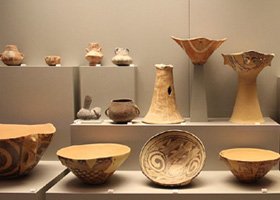 The fortress of Sesklo is located approximately 15 kilometers from Volos, adjacent to the village of the same name. The Neolithic settlement covered an area of about 200.000 m2 and had between 500 and 800 dwellings at its heyday (5000 B.C.). This community yielded remarkable finds like as painted pottery, stoned tools, and artifacts made of obsian, a material primarily found on the island of Milos.
The settlement of Dimini is located on a low hill, in a distance of about 5 kilometres way from Volos. It was occupied toward the end of the fifth millennium B.C. and covers an area of around 30.000 m2, with a population estimated at 200 - 300 people. Dimini settlement's space had been designed in a unique style. Three pairs of stone walls were built all around the community to arrange productive activities centered on agriculture and communication both internally and externally among its inhabitants.
According to the latest research, the Mycenean city of lolkos (1.400 - 1.200 B.C.) was located to the east of Dimini's prehistoric habitation hill. lolkos was a significant commercial and cultural center in the main area at the time, and its name is clearly related to the Argonautical Enterprise myth.
During historical times, the following sites were important: Pagasses (6th c. B.C.), where today's Bourboulithra is at the town's entrance, which reached its peak during the classical period, Amfanes (4th c. B.C.), where today's Soros is, and the ancient city on Goritsa hill, which was built in the first half of the 4th century B.C., most likely by Macedonian king Philippus B'.
 Dimitrias was the area's most prominent establishment during the ancient and early Byzantine periods. Macedonia's ruler Dimitrios Poliorkitis founded it in 293 B.C., uniting the neighboring towns. Dimitriada is regarded as a product of the political ideology of Alexander the Great and his descendants. It became a powerful military center for the Macedonians, from which they ruled Thessaly and southern Greece. At the same time, it was a thriving commercial center from 217 B.C. to 168 B.C. The city was planned following Hippodamus' system and was surrounded by a sturdy wall, the traces of which are still preserved today. The remains of the palace, the theatre, and the city's aqueduct, which the Romans build, may still be seen. The painted burial stelai from the city's golden period (3rd to 1st century B.C.) give fascinating information about the economy, society, and art of the time. Dimitriada began to shrivel in the 1st c. A.D., but the area remained populated until the 6th c.
Nonetheless, the colony on the hill of Agii Theodori, which is now the district of Palia, served as the town's antecedent. Because it has been constantly occupied since the early geometrical period, it harbored the Mycenean lolkos population after it was destroyed, and it was here that the town was re-established. When the Slavs threatened Dimitrias in the 6th c., its inhabitants sought refuge there as well.
There is limited evidence and no archaeological findings for the time following the 6th c. until the Turks invaded the stronghold of Palia in 1423. There have been references to the place name Dimitrias, although it is unclear whether they belong to the city constructed by Dimitrios Poliorkitis or the citadel of Palia. Nonetheless, after Constantinople was captured during the fourth Crusade in 1204, Dimitrias was held by the legendary Byzantinian line of Melissini until 1318, when it was overrun by the Catalans. In 1333, the Byzantines briefly succeeded the Catalans. The name Volos initially emerges during this time period.
From 1423, when the Ottomans dominated the area, to 1600, Greeks migrated from the seaside districts to Pilio, primarily to Ano Volos, where Dimitriada's bishop's headquarters were relocated. During this time, Pilio became the area's economic and cultural hub for the Greek community. Pilio prospered financially during the 18th c., especially near the end, thanks to trade and seafaring activities.
The beginnings of Volos as a town
Under Ottoman administration, the fortress in Palia was the only inhabited area. It housed Turks and a few Jews, and from around 1840, the castle served as the base of the Turkish ruler (Kaimakami). In 1655, Morozini's men attacked the fortress, but the Venetian occupation did not last long.
 Pilion's villages joined the Greek revolution in 1821, but were unsuccessful. The Turks sailed their fleet into Volos' harbor to gain control of the area and gather supplies for their men. The Greek state was founded in 1829, although it excluded the district of Thessaly. At that time, the harbour of Volos, known as "skala," served as Thessaly's sea outlet, connecting it to the rest of the world. Since the 18th century, transported products from Egypt, Ismyr, and Crete bound for Constantinople would end up there. During the 19th c., the shiplines from Volos to Marseilles, Hamburg, Antwerpen and Havre, came into service. Foreign embassies began to appear in Volos from in 1850, with the Greek embassy following in 1853. Volos has existed as a community from at least 1856. Volos had eighty houses in 1858, as the town developed with large streets parallel to the sea and narrow streets perpendicular to it. There were educational and administrative services.
From the Annexation to the Greek state until World War II
Volos's progress was defined by its admission to the Greek state in 1881. Volos' tradition in trading and industry, the natural harbor, and its proximity to Thessaly's plain all contributed to Volos' geograhical and economic importance, as it was the most northern harbour of the then-Greek state.
Following the annexation, development of Thessaly's railway network began, with the goal of easing the transportation crisis within Thessaly. Meanwhile, the area was being connected to the rest of Greece via Volos' harbour. Volos was connected to Larissa by railway in 1884 and to Kalambaka in 1886, establishing Volos as Thessaly's commercial center. Volos kept this position throughout the first decade of the 20th c., until Thessaly was connected to the rest of Greece via railway through Larissa. At the same time, and since 1895, the Pilio railway network connecting Volos to Milies via Lehonia had begun operations - a project that was completed in 1903.
During this time, Volos was gradually evolving from a little settlement to a vibrant modern town. The conditions were ideal for the development of financial activity, attracting businesspeople from different parts of Greece to the area. Volos' population has grown fast since its incorporation to the Greek state, reaching 11,000 in 1889, 17,000 in 1896, and 24,000 in 1907.
 The initial capital was invested in commerce and land purchases. However, the presence of capital, a domestic market, readily available raw materials, and labor resulted in the establishment of the first industries. The initial industrial achievements were primarily in the fields of agricultural machinery, textile production, and food. Furthermore, large substructure projects under construction at the time, such as Thessaly's railway and port-related projects, attracted foreigners and persons educated overseas to Volos. These individuals served as bearers of European know-how, which they imparted to the local business.
The town's growing cosmopolitanism inspired its architecture and helped to shape a spectacular cultural movement. The City Theatre was established in 1894, the Volos Gymnasium in 1896, and the "Parthenagogio" girls' high school and Volos Workers Union, Greece's first, in 1908. Many unions were active, including the "Fileleimon Athelfotis" (1897), which founded the Hospital; the Volos Trade Union (1897), which also managed a Statistics Department and a Business School; and the Volos Commercial and Industrial Union, which was founded in 1919.
The upper-class houses of Sarafopoulos (1894) and Pervanas (1900) are representative of the neoclassical style that dominated architecture, while the public buildings of the Hotel of France (1884), the City Theatre (1894), and the Thessaly Railway Administration Building (1904) are noteworthy. During the 1930s, the town's economy reaches its peak. In 1922, approximately 13,000 refugees from Minor Asia moved here and actively contributed to the town's development.
The After-War Period
The Second World War briefly halted the town's development. Volos was occupied by the Germans from 1941 to 1944, with ramifications that lasted well into the 1950s. The earthquakes in 1955 also altered the aesthetic with which the town was created, and they have been considered accountable for the town's current appearance. The time following the earthquakes and continuing into the 1970s is a reconstruction period. The town is rebuilt, an industrial zone is established in 1962, port activities expand, and the town enters its second boom period. Volos became home to the Thessaly University in 1985. However, the factories that in the 1980s even included car assembly plant for Nissan and Opel, have been declining for the last 30 years. The tourism in Volos is constantly expanding, especially as a weekend trip from other greek cities.